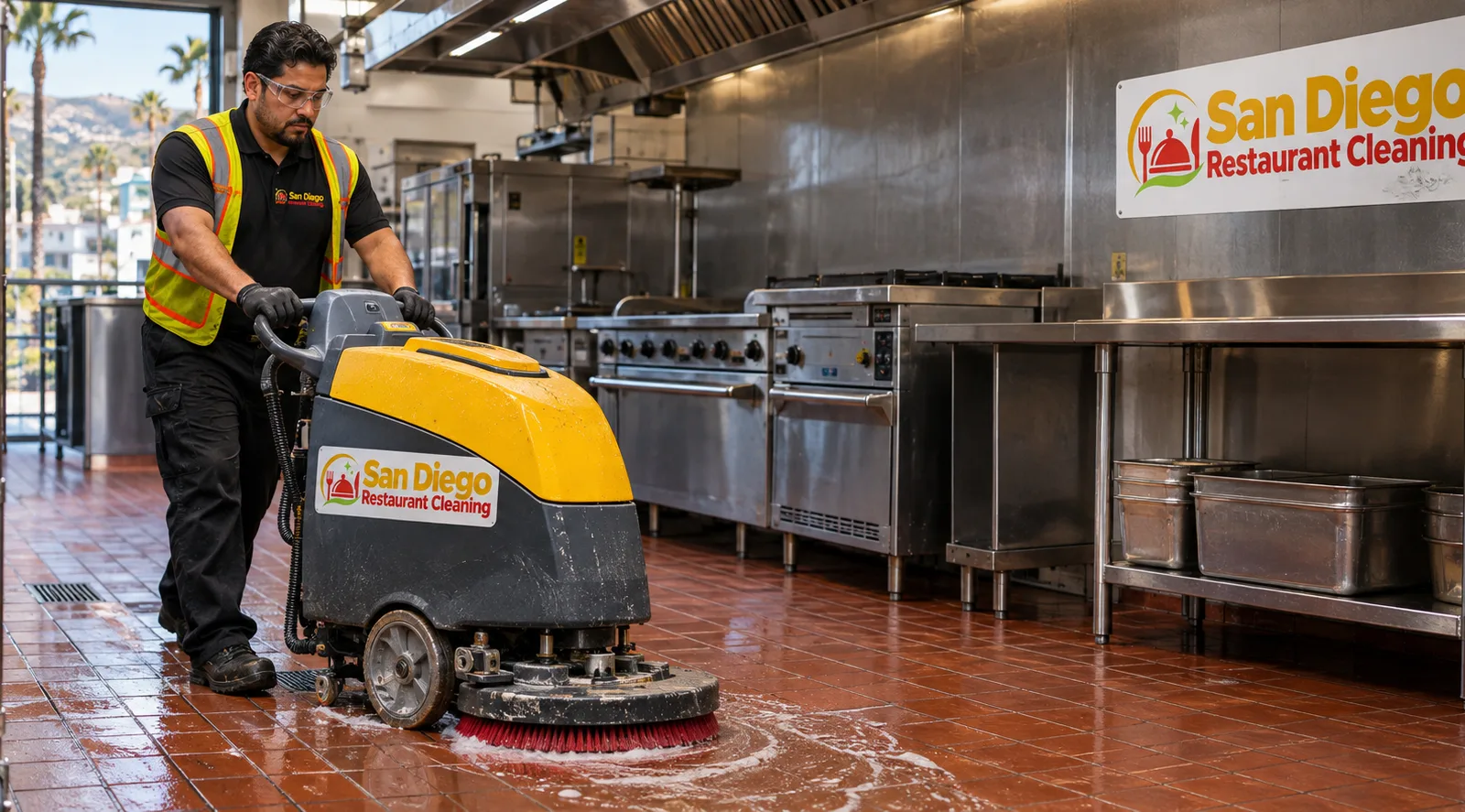
A restaurant cleaning technician using a commercial floor scrubber on a clean quarry-tile kitchen floor in Chula Vista, with stainless-steel equipment in the background.
FLOORS
Restaurant Floor Cleaning · Chula Vista

Restaurant Floor Cleaning in Chula Vista

Remove stubborn grease, tracked-in soil, and buildup with a cleaning plan shaped around your kitchen surfaces, operating hours, and food-service workflow.

✓Surface-specific methods ✓Kitchen and dining areas ✓Controlled rinse and recovery ✓Chula Vista service
DETAIL
Floor Care for Food Service

Detailed Floor Care for Working Restaurants

Restaurant Floor Cleaning Chula Vista requires more than a quick mop at closing. Cooking oil, food residue, detergent film, and soil carried through receiving doors can settle into grout lines and textured flooring. Repeated mopping may spread that residue when the solution is too weak, the water is overloaded, or the tools are already contaminated. The result is a dull floor that remains slick or sticky after it dries.

San Diego Restaurant Cleaning addresses the floor according to its material, condition, and use. Our work may include dry soil removal, degreaser application, mechanical agitation, grout-line detailing, hot-water recovery, and controlled rinsing. We pay close attention to traffic lanes, cook lines, dish areas, walk-ins, and the floor around fixed equipment. Our work as an experienced restaurant team in San Diego also fits around prep, deliveries, and opening times rather than disrupting them.

Chula Vista restaurants operate in varied settings. Busy storefronts along Third Avenue may contend with frequent front-of-house foot traffic. Properties near the Chula Vista Bayfront can receive moisture and outdoor soil at entrances, while restaurants around Otay Ranch often have broad dining areas and several transitions between kitchen, service, and customer spaces. These conditions affect equipment selection, drying plans, and the order in which areas are cleaned.

Request a Callback
Kitchen Floor Conditions

Restaurant Kitchen Deep Cleaning in Chula Vista

A kitchen floor cannot be cleaned properly without addressing the grease sources around it. During Restaurant Kitchen Deep Cleaning Chula Vista work, the floor scope can extend beneath movable equipment, along wall edges, around floor-mounted legs, and behind accessible cooking stations. Splash zones near fryers and ranges often need focused degreasing, while dishwashing areas may require attention to detergent residue and mineral film.

Quarry tile is common in commercial kitchens because it tolerates demanding use, but its grout joints can hold oily soil. Textured ceramic tile, sealed concrete, luxury vinyl tile, and resinous flooring each call for different chemistry and agitation. An alkaline degreaser may suit oily kitchen residue, while finished dining-room floors need products and pads that will not strip or haze the coating. Product dwell time matters: the cleaner needs time to loosen soil, but it cannot be allowed to dry on the surface.

San Diego Restaurant Cleaning checks accessible flooring for loose tiles, damaged grout, failed coatings, and areas where standing water could complicate cleaning. Cleaning improves surface condition, but it does not repair broken tile, restore missing grout, or correct drainage problems. Those conditions are identified before work begins so the cleaning method does not make existing damage worse.

Request a Callback
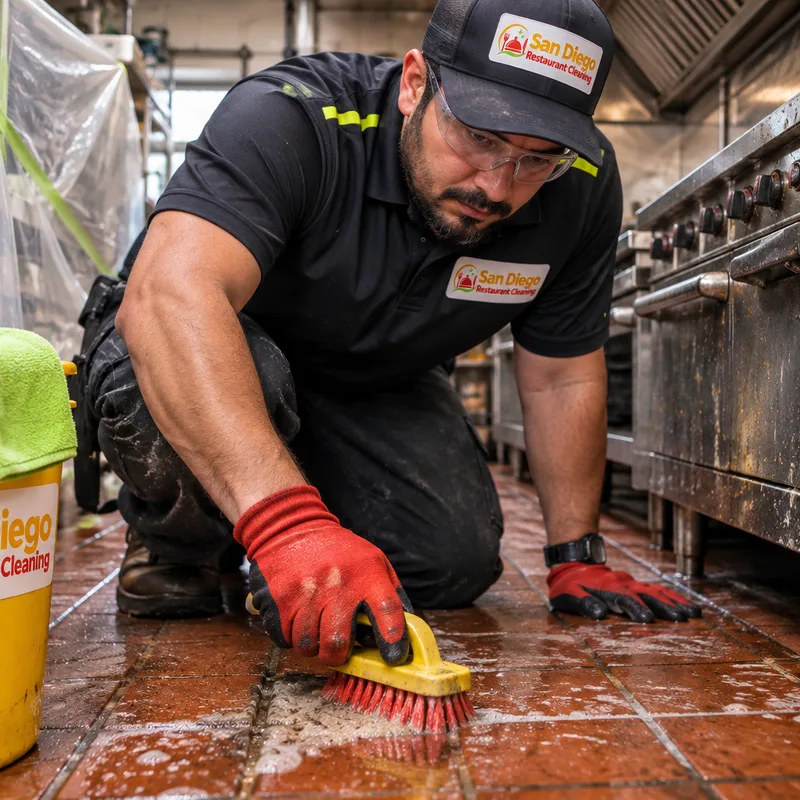
A technician mechanically scrubbing greasy grout lines on quarry tile beside a commercial cook line, with adjacent areas protected.
Mechanical agitation reaches textured tile and grout that routine mopping can miss.
STANDARD
Defined Floor-Care Scope

What a Restaurant Floor Cleaning Scope Can Cover

Back-of-house degreasing

Cook lines, prep lanes, dish areas, and other accessible kitchen zones receive chemistry selected for oily food-service buildup. Heavy deposits may require repeated agitation and recovery rather than one aggressive application.

Grout and edge detailing

Brush work targets grout joints, wall edges, corners, and equipment perimeters where large scrubber pads cannot make full contact.

Dining-room floor care

Hard dining surfaces are cleaned according to their finish. The plan can separate greasy kitchen tools and solutions from customer-facing floors to prevent cross-contamination and residue transfer.

Entrance and traffic lanes

Entrances, service paths, and routes between the kitchen and dining room tend to collect concentrated soil. These lanes receive extra passes when visual inspection shows embedded buildup.

Under-equipment access

Areas beneath equipment are included when the unit can be moved safely and the floor is accessible. Gas-connected, hard-plumbed, or fixed equipment remains in place unless a qualified party disconnects it.

Rinse and recovery

Soiled solution is recovered instead of being pushed toward walls or left to dry. A clean-water rinse may follow degreasing to reduce alkaline residue and help the floor dry without a sticky film.

From Inspection to Handoff

Our Restaurant Floor Cleaning Process

  1. Step01

    Inspect the floor and confirm access

    We identify the flooring type, soil load, sensitive finishes, drains, thresholds, and fixed equipment. The scope also records which areas must remain available and when the restaurant needs to reopen.

  2. Step02

    Prepare the work area

    Loose debris is removed, movable items are cleared, and nearby food-contact surfaces are protected as appropriate. Cleaning tools are assigned to the relevant kitchen or dining zone.

  3. Step03

    Apply the correct cleaning solution

    The product is diluted for the surface and soil. Greasy areas receive sufficient dwell time, with the solution kept wet while it works.

  4. Step04

    Agitate detailed and open areas

    Hand brushes address edges and grout, while a rotary machine or automatic scrubber handles suitable open flooring. Pad or brush stiffness is matched to the floor to limit surface damage.

  5. Step05

    Recover, rinse, and inspect

    Dirty solution is extracted or picked up, followed by rinsing when the chemistry requires it. We inspect traffic paths, corners, and grout lines and repeat targeted work where residue remains.

  6. Step06

    Allow safe drying and handoff

    The floor is left to dry before normal traffic resumes. We review any damaged grout, coating wear, or inaccessible areas observed during the work so the restaurant has a clear record of the completed scope.

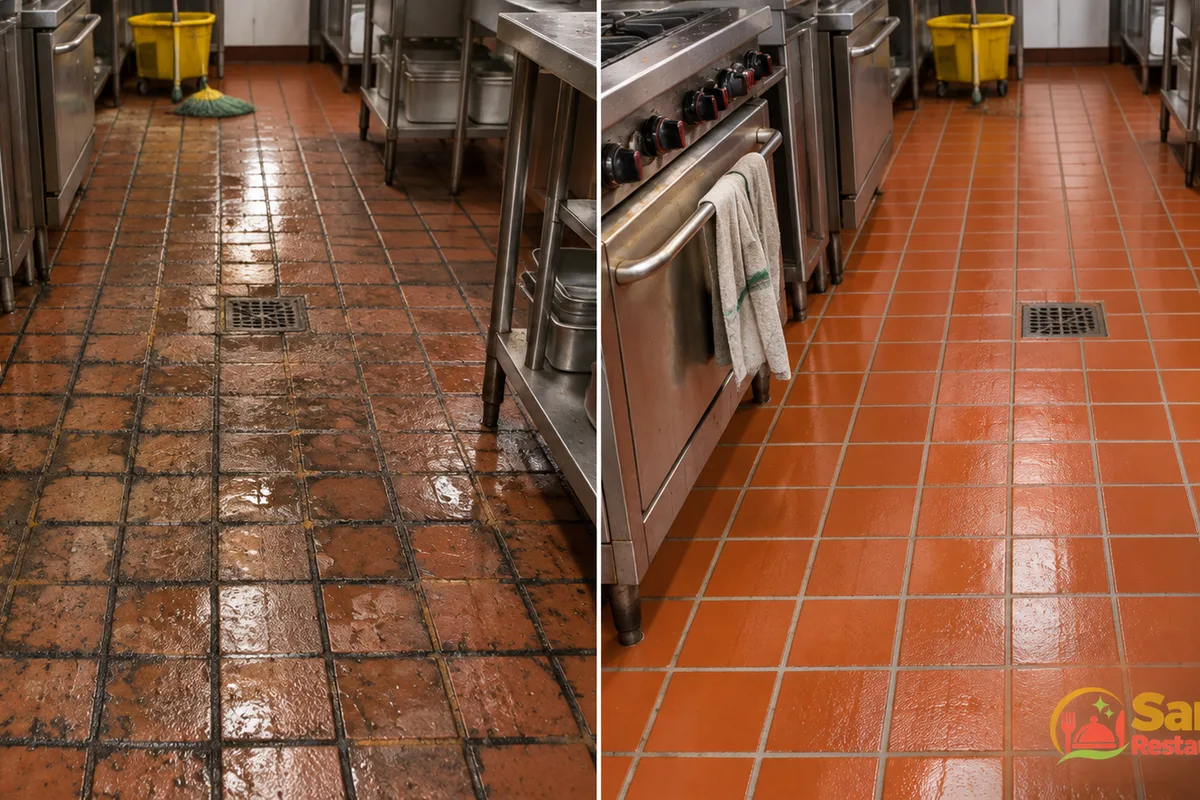
The same commercial kitchen quarry-tile floor showing dark greasy grout before cleaning and evenly cleaned tile and grout after extraction.
A useful comparison should show the same floor, lighting, and camera angle before and after cleaning.
Beyond Routine Mopping

Why Grease Returns After Routine Mopping

Grease can reappear because routine tools often redistribute it. A mop head loads quickly in a commercial kitchen, and dirty solution can settle in low spots and grout joints. Too much detergent also leaves a film that attracts soil. If kitchen and dining areas share the same mop, oily residue may move into customer-facing spaces.

A periodic deep clean breaks that cycle through stronger soil recovery and controlled rinsing. Mechanical scrubbers provide consistent agitation across open floors, while wet vacuums or extractor systems remove suspended soil. Detail brushes remain necessary around floor drains, legs, toe kicks, corners, and transitions.

Sanitation and slip prevention also depend on daily restaurant practices after deep cleaning. Use clean mop heads, follow the chemical manufacturer's dilution instructions, change solution before it becomes visibly dirty, and respond promptly to spills. Keep wet-floor controls in place until surfaces are dry. Deep cleaning supports the restaurant's maintenance program, but it does not replace daily cleaning, employee safety procedures, or food-safety duties overseen by the restaurant and the County of San Diego Department of Environmental Health and Quality.

Request a Callback
Operational Planning

Scheduling Around Chula Vista Restaurant Operations

The best cleaning window allows enough time for preparation, agitation, recovery, and drying before employees return. Overnight work may suit a late-closing restaurant, while an early-morning appointment can work for a business that opens later in the day. Split scheduling may be practical when the kitchen or dining room cannot be released all at once.

Access details can change the plan. Our team asks about loading areas, stairs, elevators, parking restrictions, alarm procedures, water access, and wastewater handling before arrival. Restaurants in compact Third Avenue storefronts may have tighter equipment access than larger spaces around Otay Ranch. A walkthrough helps determine whether a full-size automatic scrubber, a compact machine, or primarily hand-detail work is appropriate.

Weather also matters at entrances. Southern California's long dry periods can allow dust and grit to accumulate outdoors, and rainy conditions can bring wet soil inside. Entry mats and focused entrance cleaning reduce how far that material travels into dining areas. Kitchen grease requires a separate tool set and treatment plan, even when both areas are cleaned during the same appointment.

Request a Callback
Defined Before Arrival

A Clear Scope Before Cleaning Starts

Restaurant floor cleaning should be quoted around measurable conditions, not a vague promise to deep clean. Useful scope details include approximate floor area, flooring material, the number of distinct work zones, soil severity, equipment access, service timing, and whether the restaurant can provide an uninterrupted work window.

Before scheduling, tell us about recent floor coatings, known loose tiles, damaged grout, chronic standing water, or chemicals already used by staff. Photos can help with initial planning, but an on-site assessment may be needed for heavy buildup or mixed flooring. The written scope should distinguish floor cleaning from equipment disconnection, repairs, coating application, hood work, pest control, and other separate tasks.

San Diego Restaurant Cleaning is based at 3443 India St, Suite 5, San Diego, CA 92103, and serves restaurant operators seeking focused floor care in Chula Vista. The goal is a practical plan with defined access, cleaning steps, exclusions, and timing before the crew arrives.

Request a Callback

Arrange a floor assessment before grease and residue become harder to remove. We will review the surfaces, access, operating schedule, and problem areas, then outline a cleaning scope suited to your restaurant.

Call for a Free Quote
Practical Answers

Restaurant Floor Cleaning Chula Vista FAQs

Review common questions about pricing, timing, equipment access, floor materials, and cleaning frequency.

How much does restaurant floor cleaning cost in Chula Vista?+

Pricing depends on floor area, soil severity, flooring material, access, and the cleaning window. A lightly soiled open dining floor takes less labor than a greasy quarry-tile kitchen with detailed grout, fixed equipment, and restricted access. Photos and square footage can support an initial discussion, but heavy buildup or mixed surfaces may require an on-site assessment before the final price is confirmed.

How long does a restaurant kitchen floor deep cleaning take?+

A typical appointment may take several hours, while a large or heavily soiled kitchen can require a longer work window or phased cleaning. Setup, degreaser dwell time, hand detailing, mechanical scrubbing, recovery, rinsing, and drying all affect timing. Chula Vista operators should also allow enough time for the floor to dry before prep staff or delivery traffic returns.

Can you clean the floor beneath kitchen equipment?+

Yes, accessible flooring beneath safely movable equipment can be included in the scope. Equipment connected to gas, plumbing, hard wiring, or fixed ventilation should be disconnected or moved only by an appropriately qualified party. The pre-service walkthrough identifies what the cleaning crew can access and what must remain in place.

Will deep cleaning make a restaurant floor less slippery?+

Removing grease and detergent film can improve a floor's condition, but no cleaning service can guarantee a slip-free surface. Worn texture, damaged tile, failed coatings, standing water, active spills, and unsuitable footwear can still create hazards. Restaurants remain responsible for spill response, warning controls, maintenance, and employee safety procedures.

Can quarry tile and grout be cleaned without damaging them?+

Yes, sound quarry tile and grout can usually be deep cleaned with suitable chemistry, controlled dwell time, mechanical agitation, and thorough recovery. Existing loose tile, cracked grout, or deteriorated joints require caution and may need repair before aggressive cleaning. A test area is useful when the floor's prior treatments are unknown.

Do you clean dining-room floors during the same appointment?+

Dining-room hard floors can be included when their materials and finish are identified in advance. Kitchen degreasers and aggressive brushes may be unsuitable for finished customer areas, so tools, chemicals, and procedures are selected separately. Scheduling may divide the Chula Vista restaurant into zones to preserve a safe route for staff or security access.

How often should a Chula Vista restaurant schedule deep floor cleaning?+

The right interval depends on cooking volume, fryer use, foot traffic, floor texture, daily maintenance, and how quickly grease returns. A high-output kitchen may need periodic service more often than a low-grease operation. Inspection of grout color, sticky residue, edge buildup, and traction changes provides a better guide than a fixed calendar alone.

READY
Define Your Floor-Care Scope

Plan a Cleaner Restaurant Floor

Describe your flooring, problem areas, access limits, and preferred service window. San Diego Restaurant Cleaning will help define a practical scope for your Chula Vista kitchen and dining areas.